Digital Rhetoric: The Movement of Air, the Breath of Meaning Terms

Aural Composing

This method of teaching goes against the traditional style of teaching writing composition. In regards to this she writes that aurality creates functioning literate citizens that live in a world where “communications cross geopolitical, cultural, and linguistic borders and are enriched rather than diminished by semiotic dimensionality”. This might help writers by having audio versions of their work for a better understanding.

Silent Reading

“was studied through silent reading and subjected to written analysis, consumed by the eye rather than the ear”. This type of learning became normalized regardless of race or economic status. It is important for writers to keep this in mind while they produce work. Writers can learn that producing written work is not the only way to gather an audience and get one’s message across.

Modality

is the term given to different types of communication. Within the article, Selfe ties modality into auralily. She does this by stating that different forms of communication provide the idea of inclusion, as people learn different ways from every part of the globe. Modality relates to Self’s argument as she wants the reader to know that other forms of communication are valid, and are equally important and should be treated as such.


Digital Rhetoric: The Movement of Air, the Breath of Meaning

Overview:

In Cynthia Self’s article entitled The Movement of Air, the Breath of Meaning, she argues that writing composition in America is deeply flawed. Selfe goes as far to say that this curriculum limits our “professional understanding of composing as a multimodal rhetorical activity and deprive students of valuable semiotic resources for making meaning”. I like how she states that her argument is not to tear down a specific medium such as standard paper writing, but suggests all types of medium get the same level of attention. In my view, I believed her opening paragraph provided a strong Segway into her argument. Leading with an antidote allows the reader to “live in the moment” and in this specific case, her example is geared towards the demographic she is trying to reach.

Selfe goes into the idea of “sound” within the classroom, stating students are learning methods of silent reading and not much else. Regaring this method of teaching, Selfe writes that the knowledge is all “consumed by the eye, rather than the ear”. This specific idea is what stuck out to me the most. I also thought the examples she gave regarding aurality and audio composing were very effective.

Digital Rhetoric: Made Not Only in Words Terms

Composition:

“We already inhabit a model of communication practices incorporating multiple genres realated to each other, those multiple genres remediated across contexts of time and space, linked one to the next, circulating across and around rhetorical situations both inside and outside of school” (Yancey).

Curriculum:

“Developing a new curriculum for the 21st century, a curriculum that carries forward the best of what we have created to date, that brings together the writing outside of school and that inside” (Yancey).

Rhetoric:

“To accept rhetoric and composition as legitimate parts of the graduate curriculum is not a sign of dissolution, dispersion, and decomposition. It is, rather a sign that we are regaining our composure, taking composure to mean composition in all of its senses” (Frank D’ Aneglo 1980).

Digital Rhetoric: Made Not Only in Words

Overview:

In Kathleen Yancey’s work entitled, Made Not Only in Words: Composition in a New Key, she addresses the way literacy has progressed over the years. More specifically, how literacy has adapted with todays technology. Yancey opens up with the line, “Literacy today is in the midst of a tectonic change” (Yancey). She mentions how standardized testing such as the SAT’s is not yet caught up with the tectonic change. I thought it was compelling how Yancey took into account the perspective of the students who take these test in today’s technological filled world. She talks about how these kids are forced to take tests via paper and pencil, although most of their written work is composed via digital means. Some example’s include email, making presentations, and taking notes using word processors.

From there, Yancey goes back to 19th-century Britain in order to draw comparisons to the 21st-century. She states people used to read written works in “reading circles” amongst a group within communal areas. This was do to the problems which would arise when reading by one’s self such as eye strain and bad lighting. In today’s world, this activity still exists, however the means in which people communicate with each other has changed drastically. For example, people gather in Internet chat rooms. Having a platform that can be accessed from virtually anywhere offers the benefit of having diverse discussion from people around the world.

Digital Rhetoric: From Analysis to Design Terms

Source: https://www.vskills.in/certification/blog/design-conduct-and-analysis-division-b-factorial-designs/

Visuals:

Visuals (be they paintings, films, comic books, or television narratives) were to be studied in the same way as literary texts, as subject of close analysis–a use of the visual that continues throughout the history of writing instruction.

Design:

To talk of literacy instruction in terms of design means to ask writers to draw on available knowledge and, at the same time, transform that knowledge/those forms as we redesign.

Visual Composition:

For students who have grown up in a technology-saturated and an image-rich culture, questions of communication and composition absolutely will include the visual, not as attended to the verbal but as complex communication intricately related to the world around them.

Digital Rhetoric: From Analysis to Design

Source: https://www.vskills.in/certification/blog/design-conduct-and-analysis-division-b-factorial-designs/

In Diana George’s article entitled “From Analysis to Design”, she discusses how visual communication is brought into the classroom and the impact it has on students. George makes the argument that “visual literacy” should be taught in classes as students have grown up with aggressive visual culture. She states, “it is crucial to understand how very complicated and sophisticated visual communication is to students”. To back up her argument, George goes through different levels of schooling from elementry to secondary education that provide students with visual instructions. From there, George takes a look at postsecondary education and states, “writing instruction has been a tentative one in many of the same ways at those early attempts to bring mass media into English classrooms”.

I like how George made her main points stand out to the reader. She had a stand out sentence bolded and put over to the side almost like a header. Doing this provides infomation for the reader as to what the main takeaways are for that specific page. This helped alot for me as I found some of her wording and organization confusing.

Digital Rhetoric: Videos 2

This video gives a crash course on the idea of multiliteracy. For people going in blind, the above explanation is useful as the whole ideology can be daunting at first glance.

The above video clip introduces multiliteracies in regards to the field of education. It also explains the term pedagogy, and how it applies to learning and multiliteracies.

This video goes deep into how multiliteracies effect today’s world. It takes a look at how technology has changed the way we view and process language.

Digital Rhetoric: Multiliteracies & Terms

Source: https://teachingmultiliteracies.weebly.com/why-are-multiliteracies-important-for-the-literacy-development-of-middle-and-upper-primary-learners.html

According to the article, the term “multiliteracies” describes two important arguments in regards to immerging culture. The first argument “engages with the multiplicity of communication channels and media” (Cope & Kalantzis). The second argument increases the “salience of cultural and linguistic diversity” (Cope & Kalantzis).

Language – The art of language has changed form when discussing multiliteracies. Within Cope and Kalantzis’ article they write, “a good deal of this change is the result of new technologies such as iconographic, text and screen based modes of interacting with automated machinery”.

Post Fortist – This term can relate to literacy by having people learn skills such as learning organization, which in turn is essential for a writer. It focuses on a horizontal relationship of teamwork.

Critical Framing – Being able to understand cultural context in a particular work. Useful for writers as it helps understand the value of different views and ideas.

Digital Rhetoric: Chapter 1

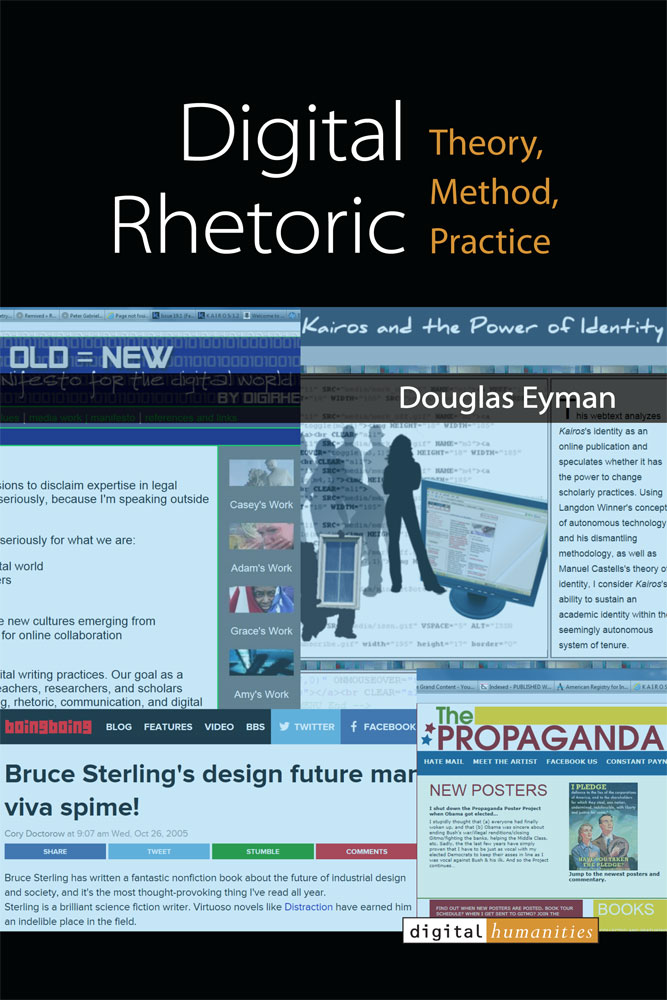
In chapter one of Eyman’s textbook, he focuses on defining the term digital rhetoric. In regards to this definition he states, “the term digital rhetoric is perhaps most simply defined as the application of rhetorical theory to digital texts and performances” (Eyman 44). He breaks down the term digital rhetoric into different fields which are as follows: digital literacy, visual rhetoric, new media, human-computer interaction, and critical code studies. Eyman goes on to address all of these fields into greater detail.

Rhetorical tradition treats language as a way to persuade, while also using symbols to affect others. Digital rhetoric is apart of this as it is also used to persuade people via communication and language. It is challenged by changing the way people view digital media for their own benefit. This could be through watching informal videos which have graphics and symbols in order for the viewer to better grasp the information.

Digital Rhetoric: Videos

The above video is discussing the basics of digital rhetoric and is useful for beginners.

Another useful video for beginners for more perspective.

This TED talk dives deep into the first incarnations of rhetoric by Aristotle and how it relates with todays technology. It gives insight on the persuasive angle of rhetoric.

Design a site like this with WordPress.com
Get started